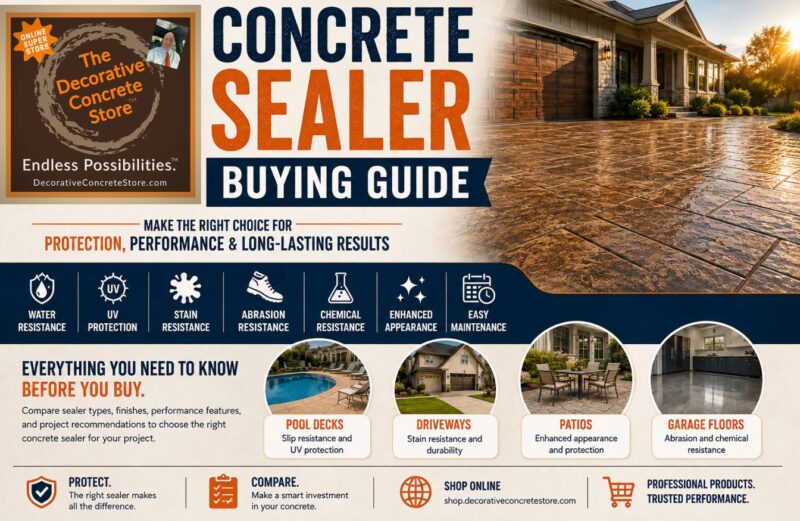
Concrete sealers are available in a variety of technologies, finishes, and formulations, each designed for different concrete surfaces and performance requirements. Understanding these differences makes it easier to compare products and choose the right sealer for your project.
This buying guide explains the key topics to compare before purchasing a concrete sealer, including sealer technologies, water-based and solvent-based products, finish options, performance characteristics, product specifications, and recommended applications. Throughout the guide, you’ll also find links to related articles that explore specific sealer types, applications, and buying topics in greater detail.
Quick Buying Checklist
Before comparing concrete sealers, ask yourself:
Surface: What type of concrete are you sealing?
Location: Is the surface indoors or outdoors?
Appearance: Natural, satin, gloss, or wet look?
Exposure: Water, sunlight, chemicals, or heavy traffic?
Performance: Abrasion resistance, slip resistance, or stain resistance?
Maintenance: How often are you willing to reseal?
Once you can answer these questions, comparing concrete sealer technologies becomes much easier.
What to Consider Before Buying a Concrete Sealer
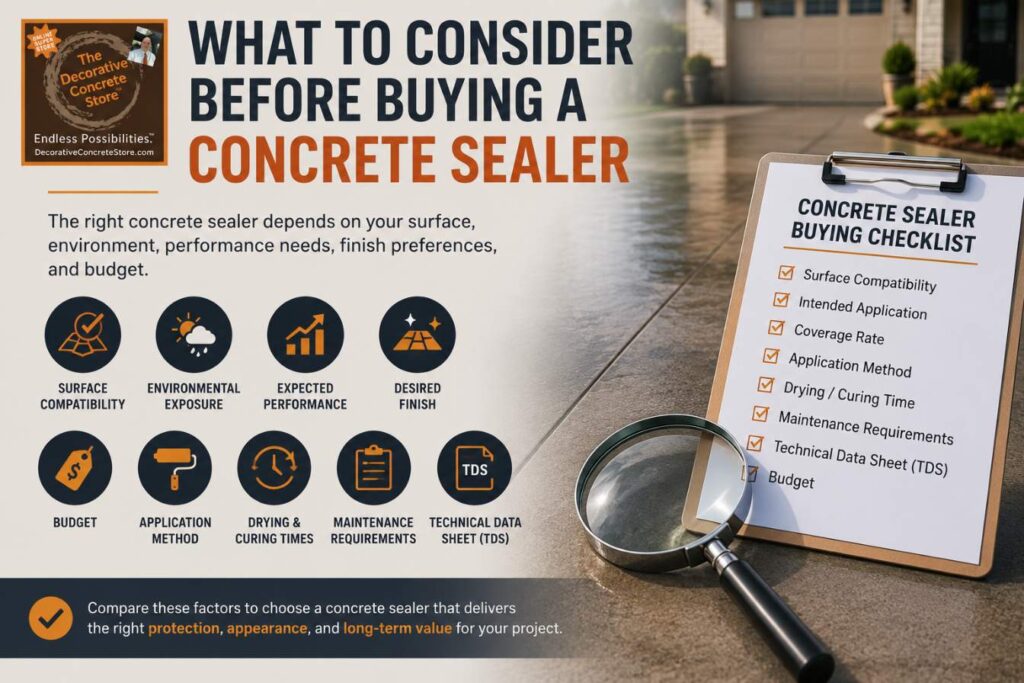
If you’re unfamiliar with how concrete sealers work, read our What Is a Concrete Sealer? guide before comparing different technologies and finishes. Surface compatibility, environmental exposure, expected performance, desired finish, and budget all influence which products are appropriate for a particular application. A product that performs well on a stamped concrete patio may not be the best choice for a driveway, pool deck, decorative concrete overlay, or commercial walkway.
Before comparing products, review information such as surface compatibility, intended application, coverage rate, application method, drying and curing times, maintenance requirements, and the manufacturer’s Technical Data Sheet (TDS). Comparing these details helps you narrow your options and select a concrete sealer that is appropriate for your project.
What Concrete Surfaces Can Different Concrete Sealers Be Used On?
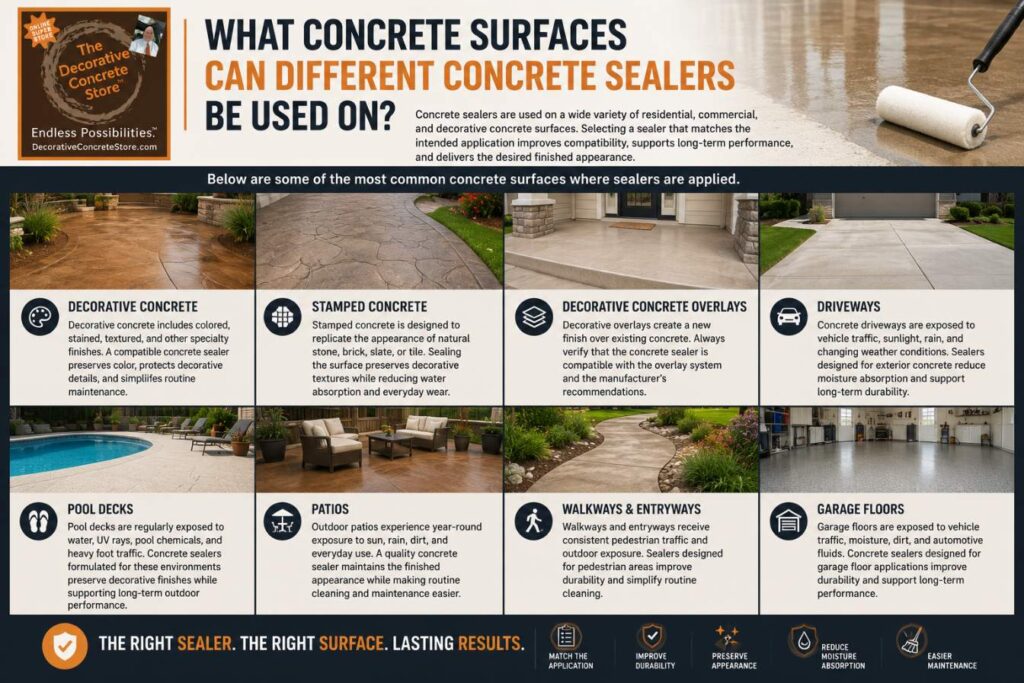
Concrete sealers are used on a wide variety of residential, commercial, and decorative concrete surfaces. Selecting a sealer that matches the intended application improves compatibility, supports long-term performance, and delivers the desired finished appearance. Below are some of the most common concrete surfaces where sealers are applied.
Decorative Concrete
Decorative concrete includes colored, stained, textured, and other specialty finishes. A compatible concrete sealer preserves color, protects decorative details, and simplifies routine maintenance.
Stamped Concrete
Stamped concrete is designed to replicate the appearance of natural stone, brick, slate, or tile. Sealing the surface preserves decorative textures while reducing water absorption and everyday wear.
Decorative Concrete Overlays
Decorative overlays create a new finish over existing concrete. Always verify that the concrete sealer is compatible with the overlay system and the manufacturer’s recommendations.
Driveways
Concrete driveways are exposed to vehicle traffic, sunlight, rain, and changing weather conditions. Sealers designed for exterior concrete reduce moisture absorption and support long-term durability.
Pool Decks
Pool decks are regularly exposed to water, UV rays, pool chemicals, and heavy foot traffic. Concrete sealers formulated for these environments preserve decorative finishes while supporting long-term outdoor performance.
Patios
Outdoor patios experience year-round exposure to sun, rain, dirt, and everyday use. A quality concrete sealer maintains the finished appearance while making routine cleaning and maintenance easier.
Walkways & Entryways
Walkways and entryways receive consistent pedestrian traffic and outdoor exposure. Sealers designed for pedestrian areas improve durability and simplify routine cleaning.
Garage Floors
Garage floors are exposed to vehicle traffic, moisture, dirt, and automotive fluids. Concrete sealers designed for garage floor applications improve durability and support long-term performance.
How Do Different Concrete Sealer Technologies Compare?
Different concrete sealer technologies are designed for different applications, levels of protection, and finished appearances. Understanding the strengths and limitations of each technology makes it easier to compare products and shop the right concrete sealer product.
Acrylic Concrete Sealers
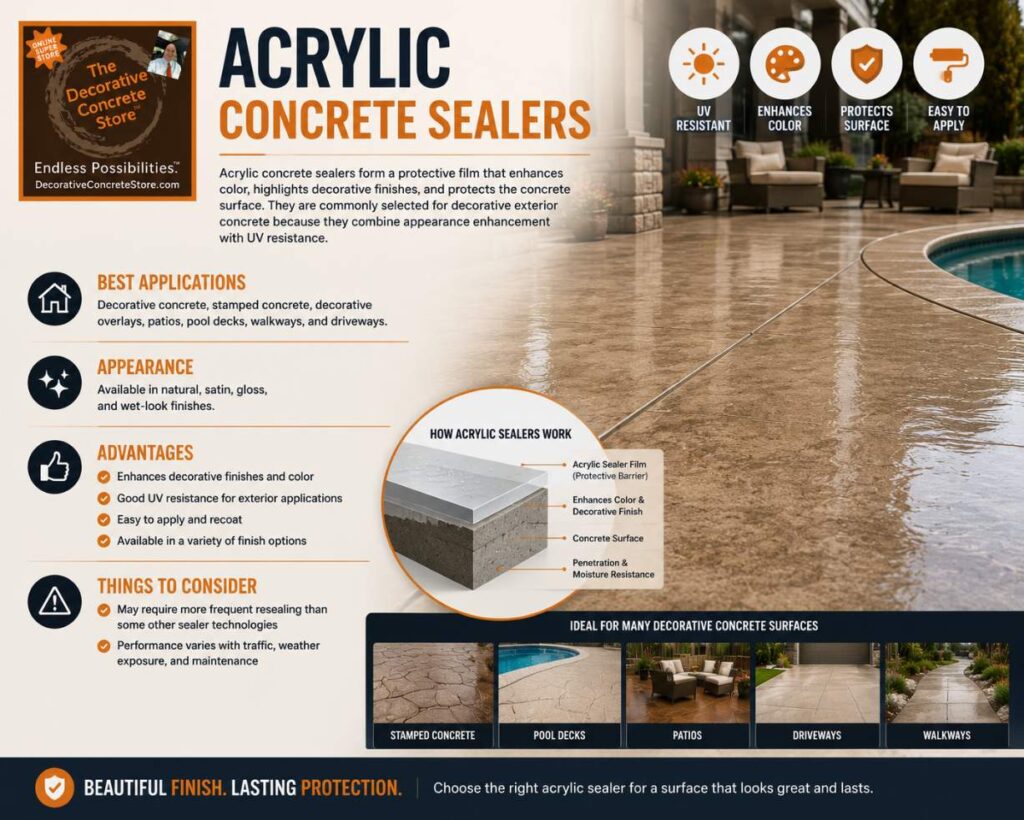
Acrylic concrete sealers form a protective film that enhances color, highlights decorative finishes, and protects the concrete surface. They are commonly selected for decorative exterior concrete because they combine appearance enhancement with UV resistance.
Best Applications:
Decorative concrete, stamped concrete, decorative overlays, patios, pool decks, walkways, and driveways.
Appearance: Available in natural, satin, gloss, and wet-look finishes.
Advantages:
- Enhances decorative finishes and color
- Good UV resistance for exterior applications
- Easy to apply and recoat
- Available in a variety of finish options
Things to Consider:
- May require more frequent resealing than some other sealer technologies
- Performance varies with traffic, weather exposure, and maintenance
Read more: acrylic concrete sealer buying guide
Penetrating Concrete Sealers
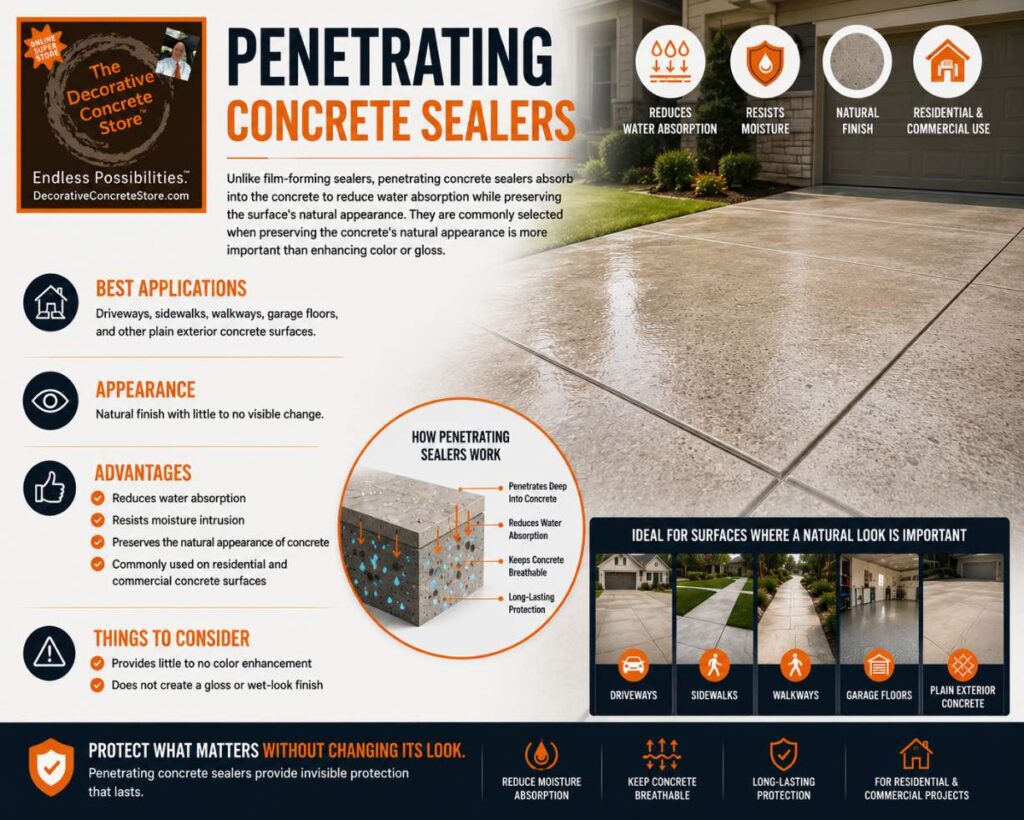
Unlike film-forming sealers, penetrating concrete sealers absorb into the concrete to reduce water absorption while preserving the surface’s natural appearance. They are commonly selected when preserving the concrete’s natural appearance is more important than enhancing color or gloss.
Best Applications:
Driveways, sidewalks, walkways, garage floors, and other plain exterior concrete surfaces.
Appearance: Natural finish with little to no visible change.
Advantages:
- Reduces water absorption
- Resists moisture intrusion
- Preserves the natural appearance of concrete
- Commonly used on residential and commercial concrete surfaces
Things to Consider:
- Provides little to no color enhancement
- Does not create a gloss or wet-look finish
Epoxy Concrete Sealers
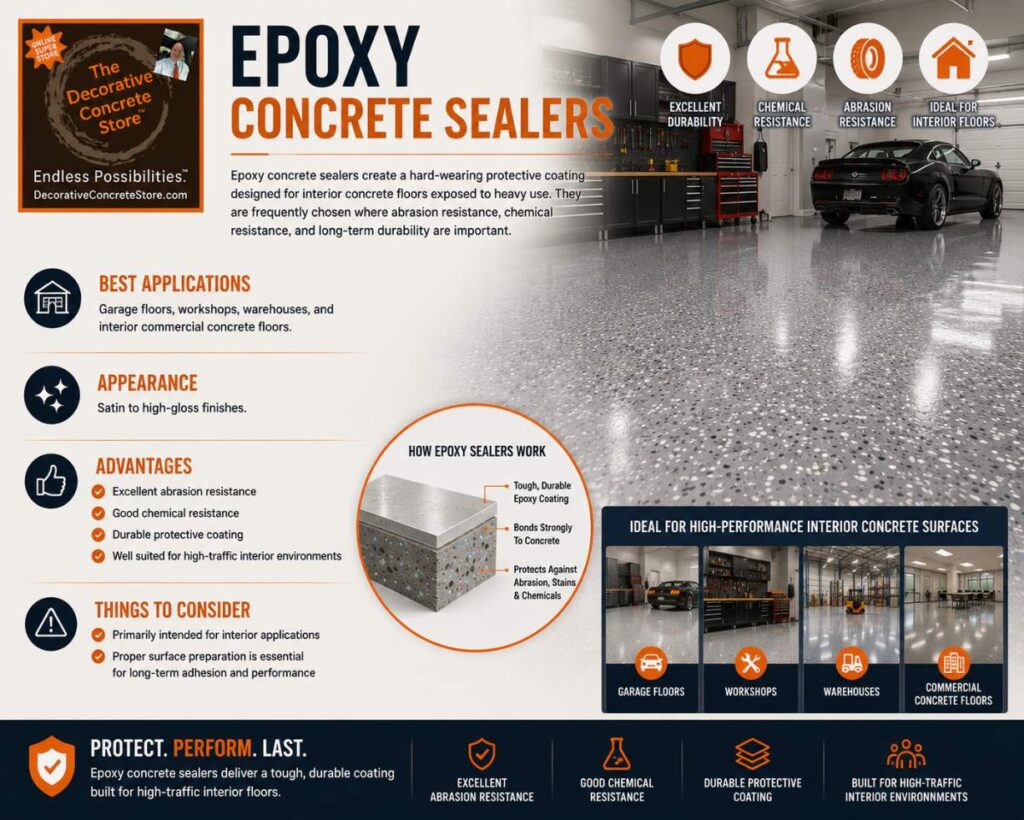
Epoxy concrete sealers create a hard-wearing protective coating designed for interior concrete floors exposed to heavy use. They are frequently chosen where abrasion resistance, chemical resistance, and long-term durability are important.
Best Applications:
Garage floors, workshops, warehouses, and interior commercial concrete floors.
Appearance: Satin to high-gloss finishes.
Advantages:
- Excellent abrasion resistance
- Good chemical resistance
- Durable protective coating
- Well suited for high-traffic interior environments
Things to Consider:
- Primarily intended for interior applications
- Proper surface preparation is essential for long-term adhesion and performance
Polyureuthane Concrete Sealers
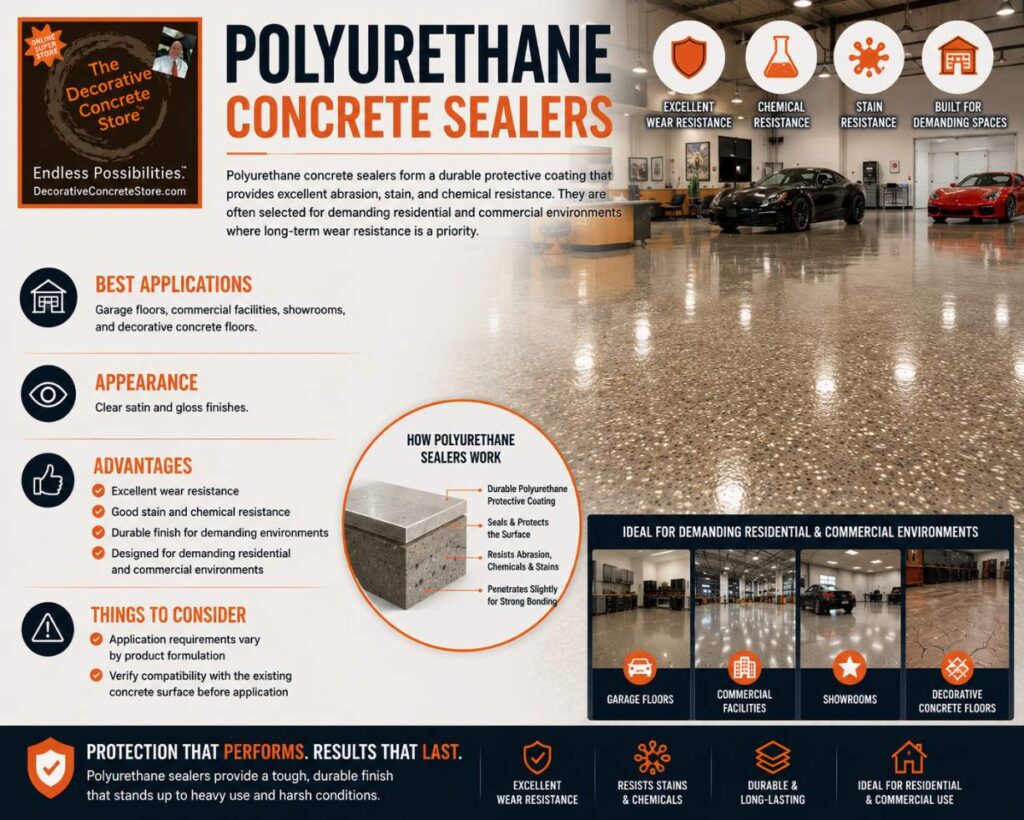
Polyurethane concrete sealers form a durable protective coating that provides excellent abrasion, stain, and chemical resistance. They are often selected for demanding residential and commercial environments where long-term wear resistance is a priority.
Best Applications:
Garage floors, commercial facilities, showrooms, and decorative concrete floors.
Appearance: Clear satin and gloss finishes.
Advantages:
- Excellent wear resistance
- Good stain and chemical resistance
- Durable finish for demanding environments
- Designed for demanding residential and commercial environments
Things to Consider:
- Application requirements vary by product formulation
- Verify compatibility with the existing concrete surface before application
Should You Choose a Water-Based or Solvent-Based Concrete Sealer?
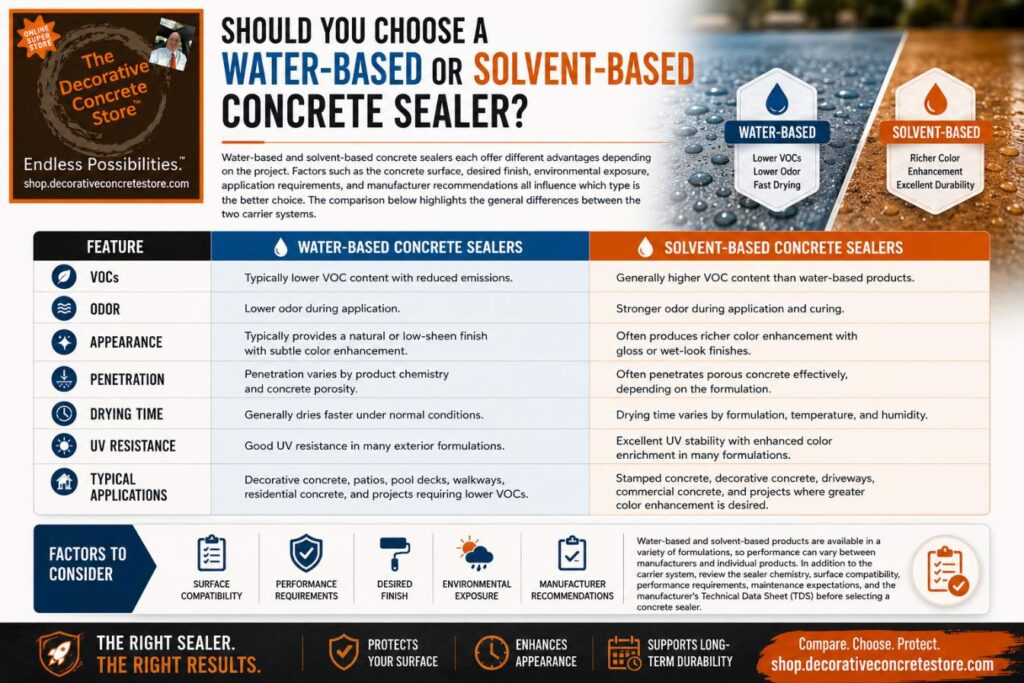
Water-based and solvent-based concrete sealers each offer different advantages depending on the project. Factors such as the concrete surface, desired finish, environmental exposure, application requirements, and manufacturer recommendations all influence which type is the better choice. The comparison below highlights the general differences between the two carrier systems.
| Feature | Water-Based Concrete Sealers | Solvent-Based Concrete Sealers |
| VOCs | Typically lower VOC content with reduced emissions. | Generally higher VOC content than water-based products. |
| Odor | Lower odor during application. | Stronger odor during application and curing. |
| Appearance | Typically provides a natural or low-sheen finish with subtle color enhancement. | Often produces richer color enhancement with gloss or wet-look finishes. |
| Penetration | Penetration varies by product chemistry and concrete porosity. | Often penetrates porous concrete effectively, depending on the formulation. |
| Drying Time | Generally dries faster under normal conditions. | Drying time varies by formulation, temperature, and humidity. |
| UV Resistance | Good UV resistance in many exterior formulations. | Excellent UV stability with enhanced color enrichment in many formulations. |
| Typical Applications | Decorative concrete, patios, pool decks, walkways, residential concrete, and projects requiring lower VOCs. | Stamped concrete, decorative concrete, driveways, commercial concrete, and projects where greater color enhancement is desired. |
Water-based and solvent-based products are available in a variety of formulations, so performance can vary between manufacturers and individual products. In addition to the carrier system, review the sealer chemistry, surface compatibility, performance requirements, maintenance expectations, and the manufacturer’s Technical Data Sheet (TDS) before selecting a concrete sealer.
Which Concrete Sealer Finish Is Right for Your Project?
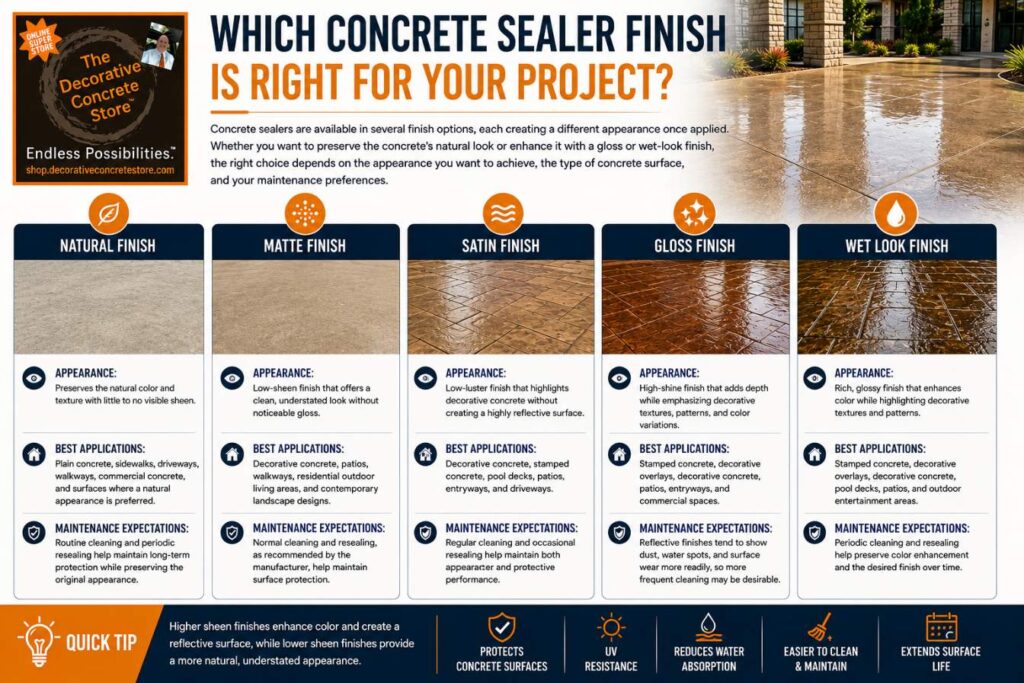
Concrete sealers are available in several finish options, each creating a different appearance once applied. Whether you want to preserve the concrete’s natural look or enhance it with a gloss or wet-look finish, the right choice depends on the appearance you want to achieve, the type of concrete surface, and your maintenance preferences.
Natural Finish
A natural finish leaves the concrete looking much like it did before sealing.
Appearance: Preserves the natural color and texture with little to no visible sheen.
Best Applications: Plain concrete, sidewalks, driveways, walkways, commercial concrete, and surfaces where a natural appearance is preferred.
Maintenance Expectations: Routine cleaning and periodic resealing help maintain long-term protection while preserving the original appearance.
Matte Finish
Matte finishes provide a soft, non-reflective appearance with minimal color enhancement.
Appearance: Low-sheen finish that offers a clean, understated look without noticeable gloss.
Best Applications: Decorative concrete, patios, walkways, residential outdoor living areas, and contemporary landscape designs.
Maintenance Expectations: Normal cleaning and resealing, as recommended by the manufacturer, help maintain surface protection.
Satin Finish
Satin finishes balance subtle sheen with moderate color enhancement.
Appearance: Low-luster finish that highlights decorative concrete without creating a highly reflective surface.
Best Applications: Decorative concrete, stamped concrete, pool decks, patios, entryways, and driveways.
Maintenance Expectations: Regular cleaning and occasional resealing help maintain both appearance and protective performance.
Gloss Finish
Gloss finishes create a reflective surface that enhances color and decorative detail.
Appearance: High-shine finish that adds depth while emphasizing decorative textures, patterns, and color variations.
Best Applications: Stamped concrete, decorative overlays, decorative concrete, patios, entryways, and commercial spaces.
Maintenance Expectations: Reflective finishes tend to show dust, water spots, and surface wear more readily, so more frequent cleaning may be desirable.
Wet Look Finish
Wet look finishes deepen color and create the appearance of freshly wetted concrete.
Appearance: Rich, glossy finish that enhances color while highlighting decorative textures and patterns.
Best Applications: Stamped concrete, decorative overlays, decorative concrete, pool decks, patios, and outdoor entertainment areas.
Maintenance Expectations: Periodic cleaning and resealing help preserve color enhancement and the desired finish over time.
Which Performance Features Matter Most When Buying a Concrete Sealer?
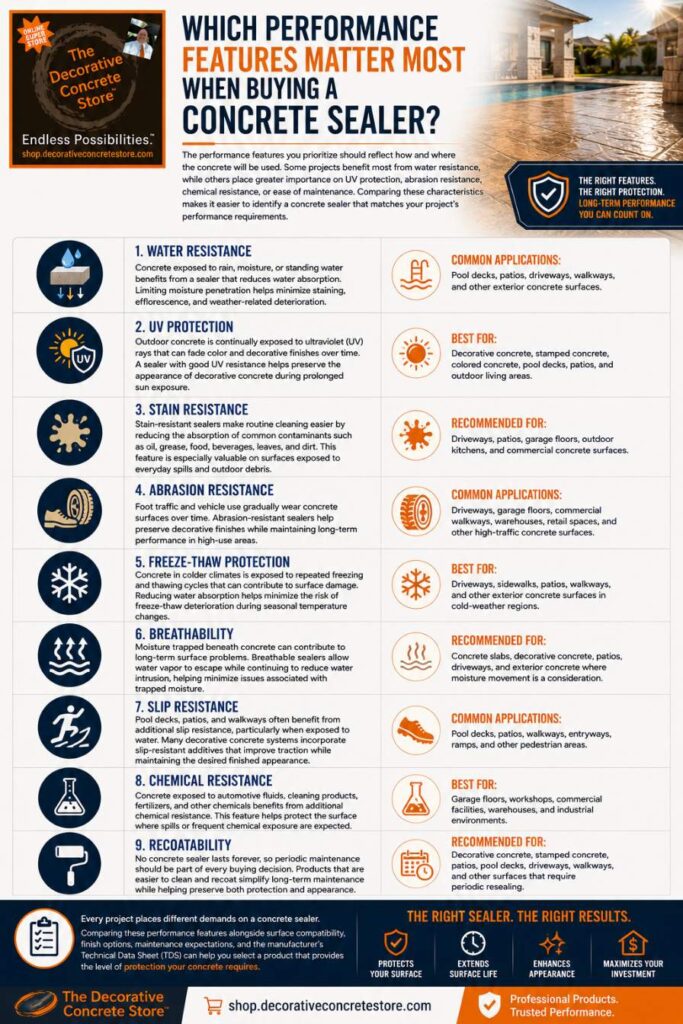
The performance features you prioritize should reflect how and where the concrete will be used. Some projects benefit most from water resistance, while others place greater importance on UV protection, abrasion resistance, chemical resistance, or ease of maintenance. Comparing these characteristics makes it easier to identify a concrete sealer that matches your project’s performance requirements.
Water Resistance
Concrete exposed to rain, moisture, or standing water benefits from a sealer that reduces water absorption. Limiting moisture penetration helps minimize staining, efflorescence, and weather-related deterioration.
Common Applications: Pool decks, patios, driveways, walkways, and other exterior concrete surfaces.
UV Protection
Outdoor concrete is continually exposed to ultraviolet (UV) rays that can fade color and decorative finishes over time. A sealer with good UV resistance helps preserve the appearance of decorative concrete during prolonged sun exposure.
Best For: Decorative concrete, stamped concrete, colored concrete, pool decks, patios, and outdoor living areas.
Stain Resistance
Stain-resistant sealers make routine cleaning easier by reducing the absorption of common contaminants such as oil, grease, food, beverages, leaves, and dirt. This feature is especially valuable on surfaces exposed to everyday spills and outdoor debris.
Recommended For: Driveways, patios, garage floors, outdoor kitchens, and commercial concrete surfaces.
Abrasion Resistance
Foot traffic and vehicle use gradually wear concrete surfaces over time. Abrasion-resistant sealers help preserve decorative finishes while maintaining long-term performance in high-use areas.
Common Applications: Driveways, garage floors, commercial walkways, warehouses, retail spaces, and other high-traffic concrete surfaces.
Freeze-Thaw Protection
Concrete in colder climates is exposed to repeated freezing and thawing cycles that can contribute to surface damage. Reducing water absorption helps minimize the risk of freeze-thaw deterioration during seasonal temperature changes.
Best For: Driveways, sidewalks, patios, walkways, and other exterior concrete surfaces in cold-weather regions.
Breathability
Moisture trapped beneath concrete can contribute to long-term surface problems. Breathable sealers allow water vapor to escape while continuing to reduce water intrusion, helping minimize issues associated with trapped moisture.
Recommended For: Concrete slabs, decorative concrete, patios, driveways, and exterior concrete where moisture movement is a consideration.
Slip Resistance
Pool decks, patios, and walkways often benefit from additional slip resistance, particularly when exposed to water. Many decorative concrete systems incorporate slip-resistant additives that improve traction while maintaining the desired finished appearance.
Common Applications: Pool decks, patios, walkways, entryways, ramps, and other pedestrian areas.
Chemical Resistance
Concrete exposed to automotive fluids, cleaning products, fertilizers, and other chemicals benefits from additional chemical resistance. This feature helps protect the surface where spills or frequent chemical exposure are expected.
Best For: Garage floors, workshops, commercial facilities, warehouses, and industrial environments.
Recoatability
No concrete sealer lasts forever, so periodic maintenance should be part of every buying decision. Products that are easier to clean and recoat simplify long-term maintenance while helping preserve both protection and appearance.
Recommended For: Decorative concrete, stamped concrete, patios, pool decks, driveways, walkways, and other surfaces that require periodic resealing.
Every project places different demands on a concrete sealer. Comparing these performance features alongside surface compatibility, finish options, maintenance expectations, and the manufacturer’s Technical Data Sheet (TDS) can help you select a product that provides the level of protection your concrete requires.
What Product Specifications Should You Compare Before Buying?
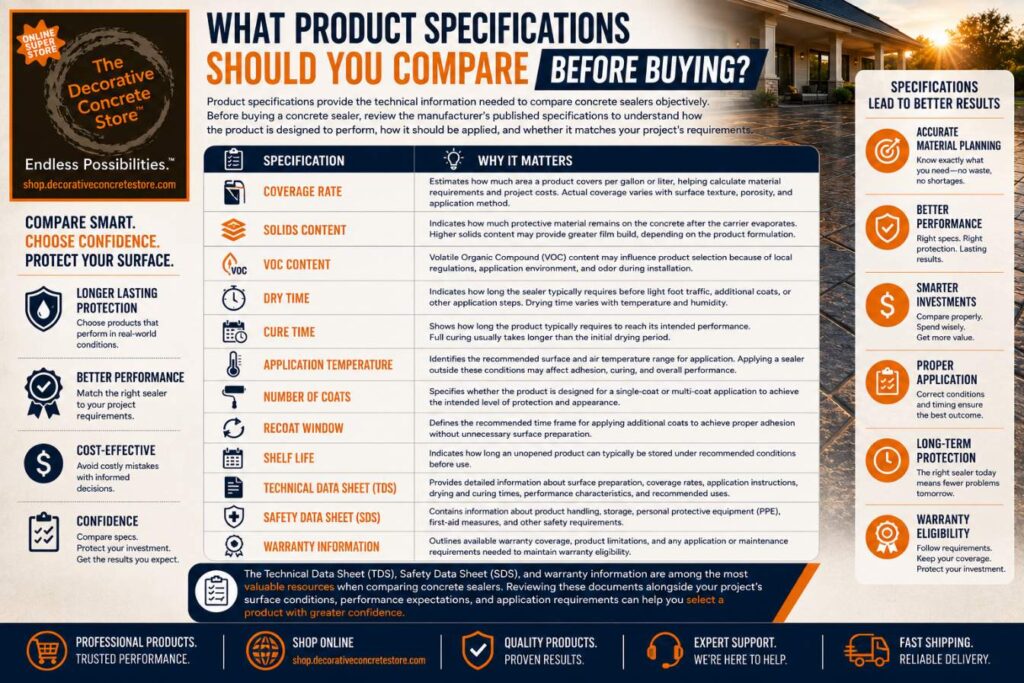
Product specifications provide the technical information needed to compare concrete sealers objectively. Before buying a concrete sealer, review the manufacturer’s published specifications to understand how the product is designed to perform, how it should be applied, and whether it matches your project’s requirements.
| Specification | Why It Matters |
| Coverage Rate | Estimates how much area a product covers per gallon or liter, helping calculate material requirements and project costs. Actual coverage varies with surface texture, porosity, and application method. |
| Solids Content | Indicates how much protective material remains on the concrete after the carrier evaporates. Higher solids content may provide greater film build, depending on the product formulation. |
| VOC Content | Volatile Organic Compound (VOC) content may influence product selection because of local regulations, application environment, and odor during installation. |
| Dry Time | Indicates how long the sealer typically requires before light foot traffic, additional coats, or other application steps. Drying time varies with temperature and humidity. |
| Cure Time | Shows how long the product typically requires to reach its intended performance. Full curing usually takes longer than the initial drying period. |
| Application Temperature | Identifies the recommended surface and air temperature range for application. Applying a sealer outside these conditions may affect adhesion, curing, and overall performance. |
| Number of Coats | Specifies whether the product is designed for a single-coat or multi-coat application to achieve the intended level of protection and appearance. |
| Recoat Window | Defines the recommended time frame for applying additional coats to achieve proper adhesion without unnecessary surface preparation. |
| Shelf Life | Indicates how long an unopened product can typically be stored under recommended conditions before use. |
| Technical Data Sheet (TDS) | Provides detailed information about surface preparation, coverage rates, application instructions, drying and curing times, performance characteristics, and recommended uses. |
| Safety Data Sheet (SDS) | Contains information about product handling, storage, personal protective equipment (PPE), first-aid measures, and other safety requirements. |
| Warranty Information | Outlines available warranty coverage, product limitations, and any application or maintenance requirements needed to maintain warranty eligibility. |
The Technical Data Sheet (TDS), Safety Data Sheet (SDS), and warranty information are among the most valuable resources when comparing concrete sealers. Reviewing these documents alongside your project’s surface conditions, performance expectations, and application requirements can help you select a product with greater confidence.
Which Concrete Sealers Are Recommended for Different Projects?
Different concrete projects require different types of protection and appearance. The most suitable concrete sealer depends on the surface, how the area is used, environmental exposure, and the desired finish. The table below highlights the sealer technologies commonly recommended for several common concrete applications.
| Project | Commonly Recommended Sealer Type | Why It’s Recommended |
| Driveway | Acrylic or Penetrating | Acrylic sealers enhance appearance and provide surface protection, while penetrating sealers reduce water absorption and preserve a natural finish. |
| Pool Deck | Acrylic + Slip-Resistant Additive | Acrylic sealers enhance decorative finishes, while slip-resistant additives improve traction on wet surfaces. |
| Decorative Concrete | Acrylic | Often chosen to enhance color and decorative finishes while providing long-term surface protection. |
| Stamped Concrete | Acrylic | Enhances texture, enriches color, and is available in natural, satin, gloss, and wet-look finishes. |
| Patio | Acrylic or Penetrating | Acrylic sealers enhance appearance, while penetrating sealers preserve a more natural-looking finish. |
| Walkway | Acrylic | Provides surface protection while enhancing the appearance of concrete exposed to everyday foot traffic and weather. |
| Garage Floor | Epoxy or Polyurethane | These coating systems are typically selected where abrasion resistance, chemical resistance, and long-term durability are important. |
Project recommendations are only one part of selecting a concrete sealer. Surface condition, environmental exposure, performance requirements, maintenance expectations, and the manufacturer’s Technical Data Sheet (TDS) should also be reviewed before making a final product selection.
Once you’ve identified the right sealer technology, visit The Decorative Concrete Store to compare available products for your project.
Frequently Asked Questions
How long does a concrete sealer last?
Concrete sealer longevity varies based on the product type, traffic, weather exposure, and maintenance practices. Some sealers require more frequent reapplication than others. Regular inspections and the manufacturer’s maintenance recommendations can help determine when resealing is appropriate.
How much concrete sealer do I need?
Coverage rates determine how much concrete sealer your project requires. The total amount varies with the size of the area, concrete porosity, surface texture, and application method. Review the product’s published coverage rate before estimating material quantities.
Can different concrete sealers be applied over one another?
Sometimes, but compatibility should always be confirmed before applying one concrete sealer over another. The existing sealer, surface condition, and new product formulation all influence whether recoating is appropriate. Review the Technical Data Sheet (TDS) before proceeding.
Can I apply a concrete sealer myself?
Yes, many concrete sealers can be applied by homeowners when the surface is properly prepared and the manufacturer’s instructions are followed. Successful results depend on thorough surface preparation, suitable weather conditions, and applying the product according to the Technical Data Sheet (TDS).
How often should concrete be resealed?
Concrete should be resealed when the existing sealer begins to lose its protective performance. The appropriate interval varies with the sealer type, weather exposure, traffic, and routine maintenance. Regular inspections help identify when it’s time to apply a fresh coat.
Does every concrete surface need a sealer?
No, not every concrete surface requires a sealer, but many benefit from additional protection. Decorative concrete, stamped concrete, driveways, patios, pool decks, and walkways are commonly sealed to help reduce water absorption, staining, and weather-related deterioration.
What is the difference between a decorative and penetrating concrete sealer?
Decorative sealers enhance the appearance of concrete while providing surface protection, whereas penetrating sealers protect below the surface with little visible change. The best choice depends on whether your priority is enhancing the finish or preserving the concrete’s natural look.
How do I know when it’s time to reseal concrete?
Reduced water repellency, fading, increased staining, and visible surface wear often indicate that concrete may need resealing. Inspecting the surface periodically and following the manufacturer’s maintenance recommendations can help determine the appropriate time for reapplication.
Can a concrete sealer change the appearance of concrete?
Yes, some concrete sealers enhance color, increase gloss, or create a wet-look finish, while others preserve the concrete’s natural appearance. The final appearance depends on the sealer technology, product formulation, and finish selected.
Should I choose a water-based or solvent-based concrete sealer?
Neither option is automatically better because each offers different advantages. Water-based and solvent-based concrete sealers differ in appearance, VOC content, odor, application characteristics, and performance. Select the option that best matches your concrete surface, project goals, and the manufacturer’s recommendations.